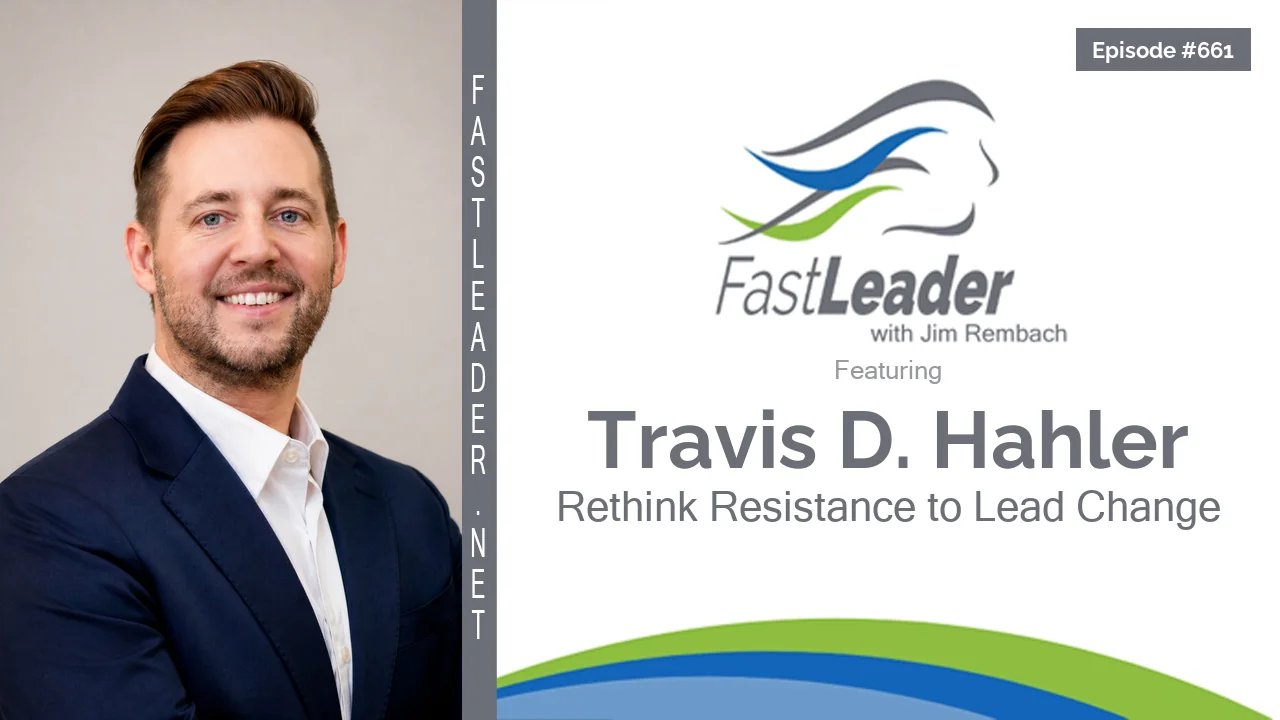
Rethinking Resistance: Why Brains Block Change and How Leaders Should Read the Signal with Travis D. Hahler
Change resistance is not a people problem to battle. It is human biology sending a check engine light, and leaders who treat it as the enemy keep repeating 70 percent change-failure rates. AI programs are now being discussed with 95 percent failure stories attached. The pattern is not mysterious. Old operating systems still rely on memory and willpower while the work asked of people has moved past unaided human capacity.
That pressure shows up as execution drift: us-versus-them campaigns, quiet dual work, rumor mills that become "truth," and teams that go silent just when you need them to speak. The more leaders force urgency, the more brains read the workplace as unsafe.
In this Fast Leader Show episode, Travis D. Hahler, senior director of global strategy and transformation at Salesforce, founder of The Neurological Nomad, and author of Rethink Resistance, explains why brains resist by design. He has guided more than 100 organizations, including Google, studied neuropsychology at Harvard, and delivered the neuroscience of change to more than 25,000 leaders. Fast Leader Show is the official podcast of Execution Architects.
Executive Summary: Key Insights
- Resistance Is Biology: Change resistance is a check engine light, not proof people are against the plan. Battling it creates us-versus-them habits instead of diagnosing the real barrier.
- The Great Scramble Overload: Pandemic-era shifts in work, power, AI, and social platforms pushed brains past focus into reaction, so intrinsic change stalled.
- AI Is Culture, Not a Tool Dump: Rolling AI out like software and saying go play lands as career threat because brains research worst-case first.
What you'll learn
- Why change resistance is biology, not proof that people are against the plan
- How the Great Scramble pushed brains past focus and into reaction
- Why AI transformation is culture and behavior, not a technology install
- The six neurological barriers that predict where change will stall
- How to stand with the team instead of triggering a threat response
Why Battling Change Resistance Keeps Initiatives From Sticking
Most leaders were trained to treat resistance as something to defeat. Travis names the habits that follow: more authoritarian "do it or else," a my-way-or-the-highway fork, or oversimplifying the change until people feel talked down to. Those moves do not create connection. They create a battle.
The neurological fact is simpler. People resist change naturally. It is not always opposition to your initiative. When you treat a check engine light as the problem, you never diagnose the engine. The light is the signal. The work is to find what it is pointing to.
What the Great Scramble Did to Focus and Human Capacity
Travis calls the pandemic years the Great Scramble. Work models shifted. Power moved. AI arrived. Social platforms exploded. Everyone grabbed whatever they could. Neurologically, people sat past the overwhelm line. Intrinsic change requires focus. Reaction does not. "I just have to get through the day" replaced "we have to adopt this behavior."
This connects that to an older systems truth. Organizations chase six-sigma error reduction while humans operate closer to one sigma. We are error machines. Pre-AI operating systems that relied on memory and willpower cannot carry today's load. That is why 70 percent change-failure rates, and the 95 percent AI implementation stories, keep repeating. Same tools. Different demand.
Why AI Transformation Is Culture and Behavior, Not Technology
AI is not a process-driven change. Travis's point is sharper: it is a behavioral and cultural shift of an entire global workforce. Most companies still approach it like a technology rollout. Give everyone access. Go play.
His bank PIN analogy shows why that lands as threat. Ask for account numbers and PIN codes and the brain jumps to "you are going to take my money," even if the other option is a gift. The same wiring shows up when leaders say "just try the AI." People hear "this will destroy my job," not "this could make my career." That is not a communications miss. It is how brains research worst-case first.
Six Neurological Barriers That Make Resistance Natural
Safety for the human brain lives in the collective. Social exclusion is toxic to change. Neural coupling is how successful transformations actually move. Then Travis names six barriers that show up most often:
- Routines. They are hard to reprogram, and replacing them requires new learning.
- Learning. The brain can learn, but it needs space, time, and energy. Corporations treat those as scarce.
- Social exclusion. Change is exclusionary by nature: someone decided, someone else must adopt.
- Ambiguity. The brain cannot sit in unknown. Today's roadmaps keep pivoting.
- Anxiety. Cross the cognitive-load line and the brain shuts down into fight or flight.
- Loss. Corporate settings rarely give the empathy loss requires, including the loss of felt competence.
Jim's add: culture is not an input the C-suite protects in a formula. Culture is the output of the collective operating system. VUCA is no longer a special environment. It is the baseline.
What Happens When Leaders Force Change Too Fast
The old burning-platform playbook said: make it urgent and people will move. That no longer works as a consistent mechanism because everything already feels urgent. Forced timelines send a red blinking light: this is not safe. People go quiet. The people you need to drive the change stop stepping up.
You may still "get the change across the line." Then month-end still takes three weeks. Dig in and you find dual work: the new system plus the old spreadsheet, because nobody was given time to become competent. Faster never arrived. You just have a prettier system beside the familiar one. That is also a loss of competency. People feel safer in the skill they already have.
How Ambiguous Messages Become Worst-Case Narratives
Brains are not designed for ambiguity. In a blank, they cannot tell need from threat, so they go to the library of past experience and fill the gap. The lens is not analytical. It is worst-case: what happened to me, my friend, someone else in the last restructure.
Then the brain validates. "Hey Jim, this is what I think is happening. What do you think?" That social step creates a movement. The rumor mill becomes the truth. Leadership can rarely discredit it, because the people inside the narrative trust each other more than they trust the official story. Peer power beats a 12-month town hall download. People do not consume information that way anymore.
What an Amygdala Hijack Looks Like in a Team Meeting
Fight, flight, and freeze are easier to spot than fawn. In the room, people stop processing. Wheels turn. Threat assessment replaces listening. In larger teams it shows up as the same questions on repeat, or a sudden reversion to old ways of working. They are not over the question yet. They have not reached safety, so they cannot think logically about the answer.
Fawn looks like "yes sir, no ma'am" and empty rooms when the CEO asks for input. It is self-preservation. Once you know the pattern, you see it the way you suddenly see a new car everywhere after you buy one.
How Leaders Accidentally Trigger the Team Threat Response
Three roles show up in change: the leader of the change (often the C-suite that decided), the recipient of the change (everyone who did not invent it), and the driver of change. Most people-leaders sit in that middle seat. It is the hardest job, because you have to change while asking other people to change.
The trap: you are so early in your own barrier journey that you deprioritize empathy. You push a process instead of asking which barrier each person is in. A team of 50 is 50 different barrier maps. The fix Travis asks for is vulnerability. Abandon the idea that you must have all the answers first. Stand with the team. "I am going through it too. Here is what I am experiencing. We will figure this out together." That turns us-versus-the-leader into all-of-us versus the change.
The first step to become more brain-aware is to learn those six barriers and reflect them on yourself. Empathy is the product. That is how you become a more neuro-focused leader without waiting for a perfect playbook.
Key Tips for Leading Change Without Fighting Biology
- Read resistance as a check engine light, not as proof of opposition.
- Budget space, time, and energy for learning, or routines will win.
- Treat AI adoption as culture and behavior, not a tool dump.
- Replace burning-platform urgency with enough time to become competent.
- Name loss, including the loss of felt competence, before dual work starts.
- Stand with the team in the change instead of arriving with all the answers.
Pros and Cons of Battling Resistance Versus Reading It
Pros of reading resistance as a signal: you diagnose the real barrier, keep high performers from going quiet, reduce dual work, and build collective safety so change can actually stick.
Cons of battling resistance: us-versus-them culture, forced urgency that reads as unsafe, rumor mills you cannot discredit, and "successful" rollouts that still run the old spreadsheet on the side.
Top 10 Proven Steps to Rethink Resistance to Lead Change
- Stop battling the light. Resistance is a diagnostic signal, not the engine failure itself.
- Name the six barriers. Routines, learning, exclusion, ambiguity, anxiety, and loss predict stall points.
- Give learning resources. Space, time, and energy are required to replace a routine.
- Treat AI as culture work. Do not roll it out like a software install and tell people to play.
- Drop burning-platform as the default. Everything already feels urgent. Forced speed reads as unsafe.
- Hunt dual work. If cycle time did not drop, people may be running two systems.
- Fill ambiguity before the rumor mill does. Worst-case stories form fast and socialize faster.
- Spot amygdala hijack. Repeated questions, freeze, fawn, and reversion to old work are threat signs.
- Stand in the driver seat honestly. You are changing too. Say so.
- Get curious before you get corrective. Empathy first is the shortest path to a brain-aware operating system.
Memorable quotes
Neurologically people resist change naturally. It's their natural response to change.
Think of it as a check engine light. The check engine light tells you there's a problem and you should go and figure out what that is.
We're talking truly about a behavioral and truly about a cultural shift of an entire workforce, not a company, an entire global workforce.
That's like me walking up to you, Jim, and saying, could you give me your account numbers for your bank accounts and your PIN numbers as well?
The narrative becomes the truth.
You have to change while asking other people to change.
Get curious before you get corrective.
Frequently asked questions
Why do so many organizational change initiatives fail?
Because leaders treat natural biological resistance as opposition. Battling it creates us-versus-them habits instead of diagnosing the real barrier.
How should leaders treat resistance instead of battling it?
Treat it as a check engine light. The light is not the problem. It tells you to go find what is stalling the change.
What are the six neurological barriers to change?
Routines, learning (space, time, and energy), social exclusion, ambiguity, anxiety, and loss. They are the natural resistance foundations Travis maps in the episode.
Why does forcing AI adoption as a technology rollout backfire?
AI is a culture and behavior shift, not a process install. "Just go play" lands as career threat because brains jump to worst-case first.
What does an amygdala hijack look like in a team meeting?
Repeated questions, freeze, fawning yes-sir answers, and sudden reversion to old ways of working. People are threat-assessing, not ignoring you.
How do leaders accidentally trigger a team's threat response?
They sit in the driver-of-change role, still early in their own change, and push process before empathy. Standing with the team reduces the us-versus-leader trigger.