
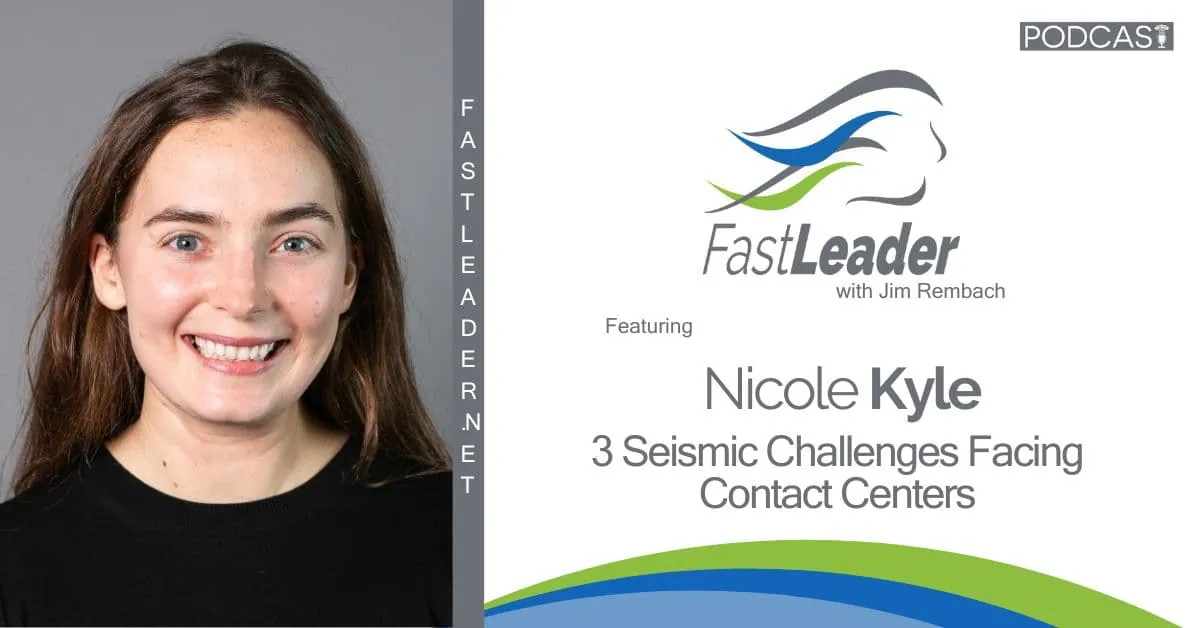
3 Seismic Challenges Facing Contact Centers
But when flexible work became normalized, with only 11% of agents desiring full-time on-site roles, the legacy operating system began to fracture.
The issue is an outdated operating system that attempts to manage modern complexity through human-scale habits rather than engineered system architecture.
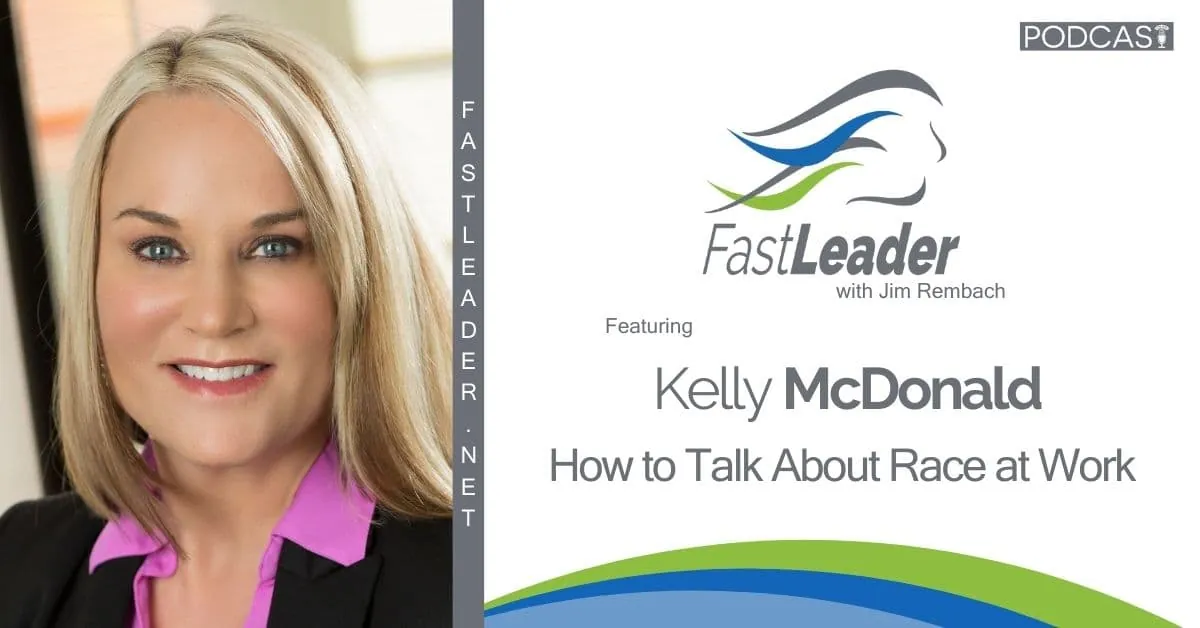
This Fast Leader Show episode covers how to Talk About Race at Work. Here is what the conversation covers, then the key insights.
The leadership teams at those companies did not lack business acumen. When Bethany Frankel pitched a low calorie cocktail to major liquor executives, every single one of them turned her down.
Executive Summary: Key Insights
Perspective Gaps Cost Market Capital:
Legacy operating models fail to capture new market opportunities when decisions rely on homogenous executive perspectives.
Unexamined Filters Drive Systemic Friction:
Subjective hiring metrics like culture fit or unwritten pedigree defaults distort objective talent evaluation.
Operational Systems Overrule Intent:
Sustainable organizational alignment requires structured environmental scaffolding rather than relying on individual willpower or training programs.
When Bethany Frankel pitched a low calorie cocktail to major liquor executives, every single one of them turned her down. The leadership teams at those companies did not lack business acumen. They simply lacked the lived perspective of how female consumers calculate calories. Two years and 400 million cases later, Beam bought the brand for 100 million dollars.
That is a multi-million dollar failure of system perspective.
We see this same pattern inside modern hiring pipelines every day. In Cincinnati, hiring teams routinely fast-tracked candidates from one specific high school over all others without ever defining what quality actually meant. A similar study at Yale revealed that evaluators dynamically shifted their hiring criteria between two identical resumes, Michael and Michelle, altering whether street smarts or formal education mattered based on their baseline preference. When our administrative design lacks clear operational scaffolding, leadership succumbs to the invisible friction of The FONE Factors.
Sit with that.
Truthfully, I didn’t recognize this structural reality until much later.
Research from the Leadership Execution Institute shows that organizations relying on legacy administrative designs experience continuous misalignment when operational complexity accelerates. When hiring and operational choices default to subjective gut feel, the enterprise incurs a heavy Drift Tax. Across an enterprise with a hundred executive roles, this invisible drag erodes up to 15% of net operating margin through rework and talent turnover.
It never shows up as a line item on your P and L.
The issue is not leadership intent or individual commitment. The issue is an outdated operating system that attempts to manage modern complexity through human-scale habits rather than engineered system architecture. When we upgrade the underlying environment, execution becomes the default path of least resistance.
With this new perspective, what will you approach differently?
When executive teams operate within homogenous perspectives, the organization develops systemic blind spots that obscure new market demands and customer needs. This operational mismatch leads to missed product innovations and misallocated capital, eroding gross margins while competitors capture adjacent market share.
Traditional training programs attempt to alter individual behavior through information delivery, which quickly degrades when leaders return to high-velocity work environments. Without updating the underlying administrative design and operational scaffolding, human biology defaults to familiar habits under daily operational stress.
Organizations must replace nebulous criteria like culture fit with objective, systemically defined competencies enforced across every hiring level. By restructuring the talent pipeline through standardized evaluation scaffolding, leadership eliminates subjective defaults while securing high-density capability.
Racial disparity is more than just a hot topic on social media. Employees constantly face threats of social injustice and racial inequality at work, and leaders need to understand that in order for their organization to thrive, they must bolster their diversity, equity, and inclusion efforts and provide a safe space for their employees to talk about race at work.
In this episode, Kelly McDonald shares leadership insights on how to talk about race at work and what your organization can do to have conversations about diversity, equity, and inclusion with your employees.
Kelly McDonald was born and raised in a suburb of Milwaukee, Wisconsin. She was one of four kids and was second oldest in the lineup. Two parents, two brothers, one sister and two boxer dogs made for a lively household, to say the least.
The suburb in which Kelly grew up was one in which, everyone was largely the same: White and middle-class. In college, she realized the world was not all White and middle-class, and she made friends with people of many different backgrounds. The insights garnered from people with different perspectives shaped her interest in marketing and selling to different market segments.
After graduating from the University of Wisconsin-Madison, she worked at global ad agencies prior to becoming a professional speaker. She has been a professional speaker for 20 years and has written four bestselling books on diversity, leadership, marketing and the customer experience.
She was the first professional speaker to teach people the value of diversity in business and how to talk about a topic that few know how to do effectively and confidently.
Kelly now lives in Denver, Colorado and when she’s not on the road speaking, she enjoys boxing (yes, boxing, not kickboxing) – and shopping for high heels. She’s also learning to play the cello.
Listen to @kellycmcdonald get over the hump on the @FastLeaderShow – Click to Tweet
“Race is not the only way to be diverse.” – Click to Tweet
“People are so afraid of saying the wrong thing that they will say nothing.” – Click to Tweet
“In business, you have to be able to talk about problems and situations that are real that might be holding the business back.” – Click to Tweet
“Diverse teams outperform non-diverse teams all the time, on every kind of business metric.” – Click to Tweet
“Diversity is any way you can be different from me.” – Click to Tweet
“Stop saying, ‘you people’ or ‘those people’.” – Click to Tweet
“Bigger, better, fewer.” – Click to Tweet
Pace yourself. It’s a marathon, not a sprint.
Self-care.
Lead by example.
Listening to different perspectives.
Kelly’s website: https://www.mcdonaldmarketing.com/
Kelly’s email: kelly@mcdonaldmarketing.com
Kelly’s book: https://amzn.to/3Av6wI7
Kelly’s Twitter: https://twitter.com/kellycmcdonald
Kelly’s LinkedIn: https://www.linkedin.com/in/kellycmcdonald/
Fast Leader Show on YouTube: https://www.youtube.com/c/FastleaderNet
Fast Leader Show on Apple Podcast: https://apple.co/364qAA2
Fast Leader Show on Facebook: https://www.facebook.com/FastLeaderShow
Fast Leader Show on Twitter: https://twitter.com/fastleadershow
Fast Leader Show on LinkedIn: https://www.linkedin.com/company/fastleader.net
Check out other episodes on diversity, equity, and inclusion: https://www.fastleader.net/diversity-equity-and-inclusion/
Thanks for tuning into this week’s episode! If the information in our weekly conversations and interviews have helped you in your journey, please head over to Apple Podcasts, subscribe to the Fast Leader Show, and leave us an honest review.
Your reviews and feedback will not only help us continue to deliver great, helpful content, but it will also help us reach even more amazing people just like you!
Fast Leader Show is the official podcast of Execution Architects. To build alignment with a post-AI operating system, visit executionarchitects.com.
But when flexible work became normalized, with only 11% of agents desiring full-time on-site roles, the legacy operating system began to fracture.
Legacy operating systems rely on manual enforcement, which forces leaders to spend energy managing friction rather than driving strategic velocity.
Rather than relying on individual willpower or periodic training workshops, the system must provide clear alignment levers within the daily workflow.
To reduce drift sustainably, organizations must upgrade from a human-scale compliance model to a system-scale design that uses environmental constraints.
Watch on YouTube, or take the audio with you.