
Unleashing Strategic Success
We see the exact same dynamic when leaders attempt to navigate career transitions or enterprise growth using traditional forward-looking roadmaps.
As class ended, a student patted the top of his own head and remarked on the great lecture, signaling that the material had gone completely over his head.
Categoriesstrategy execution
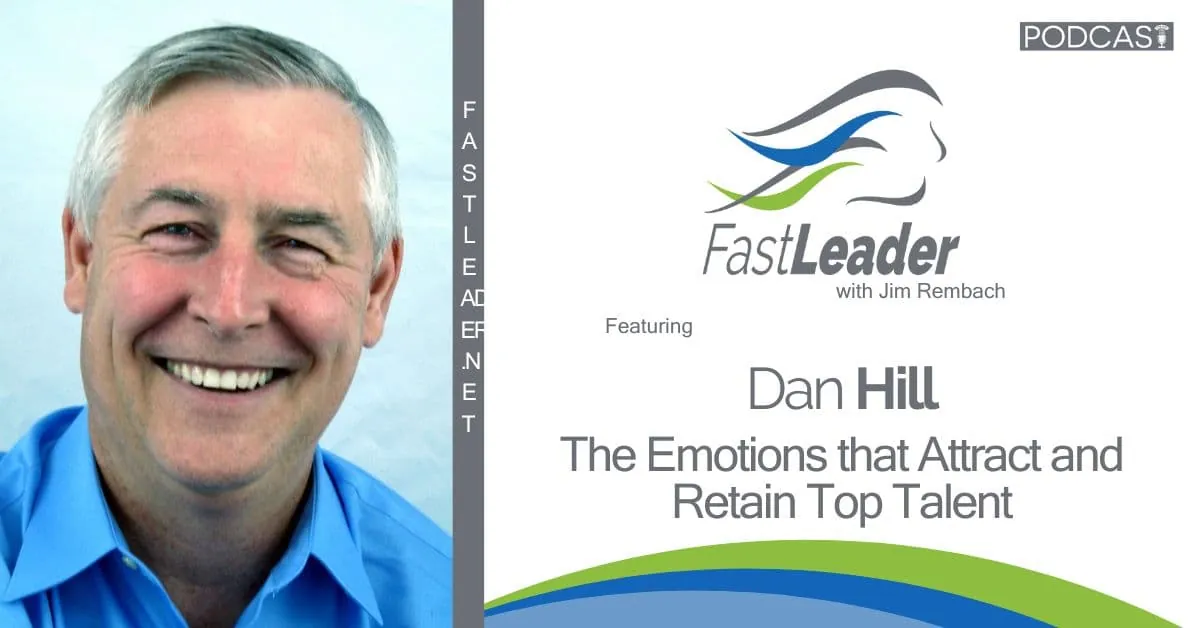
This Fast Leader Show episode covers the Emotions that Attract and Retain Top Talent. Here is what the conversation covers, then the key insights.
When Dan Hill was six years old, his family relocated to a small Italian fishing village where he did not speak the native language. Sitting in a first-grade classroom, he was forced to tune out the unintelligible speech and study the non-verbal signals of his teacher and peers to navigate his day.
Executive Summary: Key Insights
Subconscious Mechanics:
Over 90% of human decision-making stems from non-conscious emotional responses rather than purely rational evaluation.
Systemic Data Whitewashing:
Organizational hierarchy naturally filters critical ground-level operational data before it reaches executive decision-makers.
Environmental Scaffolding:
Sustainable retention requires structural systems that support human capacity under post-AI complexity rather than forcing individual compliance.
When Dan Hill was six years old, his family relocated to a small Italian fishing village where he did not speak the native language. Sitting in a first-grade classroom, he was forced to tune out the unintelligible speech and study the non-verbal signals of his teacher and peers to navigate his day. That early experience revealed a fundamental truth about human interaction that most enterprise leaders overlook. We spend millions attempting to direct organizations through explicit verbal mandates, forgetting that human biology reads environmental cues long before processing strategic instruction.
Structure governs behavior.
Dan shared another telling story about his father, an executive at 3M who managed major production lines. His father observed that the higher an executive rose in the corporate hierarchy, the more critical operational data was whitewashed before reaching their desk. When leadership receives sterile, filtered reports, they make strategic decisions isolated from operational reality. That breakdown creates an invisible financial drain across frontline teams, what we call The Drift Tax.
Sit with that for a second.
I did not see it either, not at first. I recall a moment in Dan’s career when he was lecturing as a university professor and believed he had delivered his finest presentation of the semester. As class ended, a student patted the top of his own head and remarked on the great lecture, signaling that the material had gone completely over his head. How often do enterprise executives deliver strategic directives, only to have their workforce smile and revert to their Biological Autopilot the moment the town hall ends? The traditional pre-AI operating system relies on willpower and manual oversight, expecting human cognitive capacity to absorb exponential complexity without structural support.
Willpower does not scale.
We cannot solve modern operational complexity by demanding more emotional fortitude from exhausted leaders who are navigating environments built for a slower era. When we install supportive execution architecture, we remove the cognitive friction that forces leaders into defensive postures and allow genuine organizational alignment to take hold naturally.
Now that you know better, what will you choose to do differently?
Subconscious emotional processing dictates how human beings evaluate risk, safety, and alignment within an operational environment. When an outdated operating system subjects leaders to continuous ambiguity, their biological autopilot defaults to protective routines, delaying decisions and avoiding necessary operational adjustments. This dynamic creates structural friction across workflows, leading to costly rework, reduced productivity, and unexpected talent attrition that quietly erodes corporate margins.
Traditional leadership development relies heavily on classroom instruction and information delivery, assuming that smart people will translate theoretical concepts into daily habits. Research demonstrates that over eighty percent of trained behaviors evaporate within weeks because the surrounding operational environment remains unchanged. Without structural scaffolding and environmental alignment levers to guide daily routines in the flow of work, leaders naturally revert to legacy behaviors under operational stress.
Data whitewashing occurs when legacy reporting structures filter out operational friction to protect comfort, leaving senior leaders with incomplete diagnostic visibility. Organizations must replace manual, subjective status updates with objective execution architecture that measures behavioral stability directly within daily workflows. By creating transparent feedback loops and quiet structural guardrails, leadership gains accurate operational insight without triggering protective, defensive responses across management tiers.
The importance of emotions in attracting and retaining top talent in the workplace cannot be overstated. According to research, employees are more likely to stay with a company that encourages and values positive emotions, such as gratitude, appreciation, and hope, and is more likely to attract them to the organization. Employee satisfaction can be improved as a result of these emotions, which can result in a positive work culture.
The opposite effect can be achieved, however, when negative emotions are present, such as fear, anger, and anxiety. In the presence of toxic work environments characterized by negative emotions, high turnover rates and difficulty recruiting and retaining employees can occur.
As an organization, it is crucial to establish a positive work environment that fosters positive emotions and maintains a healthy work-life balance in order to attract and retain top talent, which leads to an increase in productivity and profitability.
In our latest episode, Dan Hill discusses the role of emotions in attracting and retaining top talent. Explore how cultivating positive emotions such as appreciation and gratitude can enhance employee satisfaction and create a positive work culture. Additionally, we examine the negative effects of emotions such as fear and anger on employee retention, as well as how to achieve a healthy work-life balance. Discover how to attract and retain top talent using emotions in our episode with Dan Hill.
Dan Hill was born in Minot, North Dakota, and mainly raised in East Dakota (more commonly known as Minnesota), Dan’s childhood had one major, unique disruptive event. At age 6, the family (including his mom and sister) all moved to Italy because his dad had received an assignment from the 3M Company to manage a film processing plant along the Italian Riviera. Suddenly, Dan found himself in 1st grade in an Italian fishing village – and not knowing the language – he could only participate in the math lessons. All of his other time went to reading the body language of his new classmates and teacher and trying to get “the lay of the land.”
A year and a half later, as the family was heading to England to get a boat home to America came a 2nd, ultimately significant event: in Amsterdam, Dan saw the paintings of Rembrandt – which spurred his interest in emotions, personalities, and expressions. It’s on our faces that we best reveal our feelings. Eventually, Dan would be an art history minor in college at St. Olaf College before going on to receive a Ph.D. in English from Rutgers University.
Ever since his early adventures in Europe, Dan has been an explorer – curious about learning more about most everything. Nothing remains more fascinating, however, than human nature. The 3rd big event in Dan’s life, and his career, came in 1998 when Dan was working at a consulting company focused on the customer experience, trying to ghost-write a book for the company’s president, and somebody, his boss, new at IBM sent over an article about the breakthroughs in brain science and their implications for business. The underlying truth – about 95% of our mental activity is subconscious, and our reactions to the world are primarily sensory and emotive (not rational).
Armed with that insight, Dan decided to launch his own company, Sensory Logic, which pioneered the use of the scientific tool called facial coding to capture and quantify customers’ emotional experiences. His company has gone on to do work for over 50% of the world’s top 100 business-to-consumer companies, and he’s also applied the tool in presidential politics and pro sports. Dan’s contribution to society and the business world is bringing the role of emotions front and center. Since Dan’s pioneering efforts, major players like Apple, Facebook, Google, Microsoft, and Amazon have followed his lead. The Economist magazine has described the result of combining AI with the automation of facial coding as the emerging “facial-industrial complex.”
Nowadays, Dan lives in alternating seasons in St. Paul, MN and Palm Desert, CA, with his wife, a retired clothes designer. When not working, you’re likely to find him either on a tennis court or watching a movie for fun.
Listen to @EmotionsWizard get over the hump on the @FastLeaderShow – Click to Tweet
“Someone who is growing is a sympathetic person who is making the same parallel journey.” – Click to Tweet
“We are looking for survival, and so, we hear the bad news more loudly.” – Click to Tweet
“If you are looking for talent, look for engagement. Are they emotionally alive? You want motivated employees.” – Click to Tweet
“Motivation and emotion have the same root word in Latin – to move, to make something happen.” – Click to Tweet
“Happy people brainstorm to superior solutions more quickly.” – Click to Tweet
“Contempt is a combination of happiness and anger.” – Click to Tweet
“If trust is the emotion of business, contempt is its opposite.” – Click to Tweet
“There are only two currencies in life. Dollars and emotions. We have feelings. They drive outcomes.” – Click to Tweet
Patience.
Not spending enough downtime with people.
Ask more questions but then listen to the answers.
Facial Coding.
Emotionomics 2.0: The Emotional Dynamics Underlying Key Business Goals
Dan’s email: dhill@sensorylogic.com
Dan’s Twitter: https://twitter.com/EmotionsWizard
Dan’s LinkedIn: https://www.linkedin.com/in/dan-hill-emotionswizard/
Sensory Logic website: https://www.sensorylogic.com/
Fast Leader Show on YouTube: https://www.youtube.com/c/FastleaderNet
Fast Leader Show on Apple Podcast: https://apple.co/364qAA2
Fast Leader Show on Facebook: https://www.facebook.com/FastLeaderShow
Fast Leader Show on Twitter: https://twitter.com/fastleadershow
Fast Leader Show on LinkedIn: https://www.linkedin.com/company/fastleader.net
Check out Dan Hill’s previous episode: https://www.fastleader.net/danhill/
Thanks for tuning into this week’s episode! If the information in our weekly conversations and interviews have helped you in your journey, please head over to Apple Podcasts, subscribe to the Fast Leader Show, and leave us an honest review.
Your reviews and feedback will not only help us continue to deliver great, helpful content, but it will also help us reach even more amazing people just like you!
Fast Leader Show is the official podcast of Execution Architects. To build alignment with a post-AI operating system, visit executionarchitects.com.
We see the exact same dynamic when leaders attempt to navigate career transitions or enterprise growth using traditional forward-looking roadmaps.
The throughline connecting all the dots in his career, or what some would call his “Blue Flame,” is this: helping people find new ways to be successful.
When frontline leaders are forced to manage cross-silo coordination through manual oversight, biological autopilot routines take over to conserve energy.
This creates internal coordination drag, forcing teams to spend vital cognitive capacity managing internal processes rather than delivering market value.
Watch on YouTube, or take the audio with you.