
Remote Contact Center Engagement: Beating the Industry by 11 Points and Crawling with AI
Jason Mercer-Pottinger explains how remote contact centers use frontline autonomy and a measured AI approach to protect empathy and patient care.
But when flexible work became normalized, with only 11% of agents desiring full-time on-site roles, the legacy operating system began to fracture.
This Fast Leader Show episode covers 3 Seismic Challenges Facing Contact Centers. Here is what the conversation covers, then the key insights.
Yet when her team regressed manager behaviors against agent retention, emotional intelligence was not the primary lever; autonomy was. We spent decades managing to rigid processes.
Executive Summary: Key Insights
Manager Dynamic Shift:
Supervisor effectiveness in distributed environments requires empowering teams with autonomy rather than relying solely on traditional empathy training or rigid process enforcement.
Operationalized Flexibility:
True flexibility extends beyond work location to include hours, shift types, and task distribution, which can be managed systematically through mechanisms like flexibility banking.
Career Path Architecture:
Frontline agents increasingly view contact center roles as long-term careers, requiring structured development pathways that function effectively across hybrid and remote settings.
When Nicole Kyle shared CMP Research’s findings from studying distributed enterprise contact centers, one statistic immediately stopped me in my tracks. 90% of executives were doubling down on empathy training, assuming emotional connection alone would solve frontline attrition. Yet when her team regressed manager behaviors against agent retention, emotional intelligence was not the primary lever; autonomy was.
We spent decades managing to rigid processes.
In traditional operations, process adherence was treated as the ultimate guarantee of performance, and supervisors were trained to enforce every rule verbatim. But when flexible work became normalized, with only 11% of agents desiring full-time on-site roles, the legacy operating system began to fracture. When organizations force rigid procedural compliance onto distributed teams, supervisors default to their Biological Autopilot and mistake micromanagement for operational control.
Control without flexibility creates drag.
Nicole described how one small contact center, bound by strict 8 AM to 10 PM coverage windows, solved this constraint by creating a flexibility bank where agents earn and redeem flexible hours. That structural adjustment gave agents permission to exercise judgment while preserving essential service levels. Without system-level scaffolding to support procedural flexibility, teams experience severe Execution Drift as managers burn out attempting to enforce outdated administrative controls.
Now that you see the bigger picture, what will you do differently?
Legacy administrative designs were engineered for co-located environments where supervisors could physically observe and assist frontline staff. In remote or hybrid settings, forcing strict adherence to rigid scripts strips agents of discretion and increases cognitive load during complex customer interactions. When human capacity is exceeded by operational complexity, enforcing rigid process over problem resolution creates friction that degrades both customer satisfaction and workforce retention.
When organizations rely on outdated management frameworks, supervisors are placed in the unsustainable position of enforcing rigid metrics while managing distributed teams. This structural mismatch leads to supervisor burnout and elevated turn rates across the management layer. The financial impact extends far beyond direct recruiting costs, creating a compounding tax on operating margins through lost institutional knowledge, reduced team coaching quality, and elevated frontline turnover.
Small contact centers often struggle with flexibility due to tight staffing requirements across fixed operating hours. Rather than treating flexibility as an all-or-nothing policy, organizations can introduce structural mechanisms such as flexibility banking. This framework allows agents to earn and redeem flexible time off or shift adjustments based on performance markers, preserving operational coverage requirements while delivering the autonomy modern workforces require.
In this episode of the Fast Leader Show, Jim Rembach welcomes Nicole Kyle, an expert in the contact center industry since the 1990s. Nicole seeks to understand the current challenges in the industry and explores three seismic challenges facing contact centers. While skill development has been a focal point, Nicole emphasizes the importance of career development and how the majority of agents now view their role as a long-term commitment.
Nicole introduces a competency model for leaders consisting of seven competencies, with a mix of hard and soft skills. This model emphasizes the significance of how leaders engage with their teams and work together, rather than just following processes. Their company offers certifications in these competencies, recognizing their value in developing effective leaders.
Flexibility is crucial in structuring career development, and Nicole’s company uses a segmentation model to categorize employees based on their motivators. This enables them to tailor career development programs to individual needs. Moreover, Nicole expands on flexibility in the workplace, encouraging leaders to consider not only work location but also the type of work and distribution of tasks to prevent burnout and foster engagement.
Agent engagement and retention are major challenges for customer contact leaders due to the ongoing shift in the labor market. These challenges revolve around effective management dynamics, operationalizing flexibility, and offering flexibility that meets personal needs. Nicole’s insights on leadership competencies, personalization, motivation strategies, and operationalized flexibility provide valuable guidance for industry professionals.
Tune in to this episode of Fast Leader Show to gain valuable insights on navigating the current challenges in the contact center industry and learn how to maximize agent engagement and retention. Get ready to rethink leadership and career development strategies for a future of flexible work.
Nicole Kyle is Managing Director and co-founder of CMP Research. She was born and raised in Rhode Island and is an only child. Nicole’s been playing tennis since she was 7 years old and loves to read fantasy books to “escape.” She started her career in customer contact research in 2012.
Nicole joined CMP in November 2021 from Gartner, where she spent eight years leading research and advisory. Nicole is known for her exceptional work in customer contact, future of work, future of workplace, and employee engagement, delivering frame-breaking insights that have supported critical decision-making across hundreds of enterprise-level leadership teams. Prior to Gartner, Nicole was a journalist and still maintains the natural curiosity of a journalist in her research.
She works on publishing on gender equity, the gender wealth gap, women’s relationship to money, and educating normies, creators, & historically excluded communities about crypto and web3. Co-creator and co-host of I Also Want Money, a podcast to demystify, demasculinize and democratize wealth. She creates content to explore the intersection of money, equality, creativity, and technology. The historic concentration of wealth oppresses and excludes; closing the gender, racial and social wealth gaps, is essential to drive real change.
The legacy she is proud to leave behind includes contributing to positive change.
She resides in Brooklyn, NY.
Fun Fact: Nicole lived and worked in London for five years.
Listen to @nicolekyle get over the hump on the @FastLeaderShow – Click to Tweet
“Skill development is important, but it only goes so far on the career development journey. Agents view their role as a career, not just a job.” – Click to Tweet
“Leadership competency models should focus on both hard and soft skills. It’s about how leaders engage with people and work as a team.” – Click to Tweet
“Flexibility in the workplace extends beyond work location. It should include the type of work and distribution of tasks to prevent burnout.” – Click to Tweet
“The major challenge for contact center leaders is agent engagement and retention. Effective managers and flexible work options are top priorities.” – Click to Tweet
“Empathy training and emotional intelligence are crucial competencies for highly effective managers in a flexible and distributed context.” – Click to Tweet
“Personalization is key in engaging agents. Our segmentation model helps managers understand their team members’ starting points and aptitude for flexibility.” – Click to Tweet
“Short-term, external-based motivation strategies create long-term issues. Identifying a starting point is necessary to improve performance and tenure rates.” – Click to Tweet
“Operationalizing flexibility is a significant driver of agent satisfaction and retention. It goes beyond just offering remote or hybrid work arrangements.” – Click to Tweet
“People now recognize the transferable skills gained from customer contact and are interested in developing a career in the field.” – Click to Tweet
“Knowing the potential career development in customer contact improves agent satisfaction. Agents need clear paths for advancement and opportunities in the business.” – Click to Tweet
Be more confident. Confidence allows you to break free from those holding you back.
Self-doubt.
Do not take advice from people from whom you would not seek it.
Listening.
Nicole’s Twitter: https://twitter.com/nicolekyle
Nicole’s LinkedIn: https://www.linkedin.com/in/nicolekyle/
CMP Research website: https://www.cmpresearch.com
Fast Leader Show on YouTube: https://www.youtube.com/c/FastleaderNet
Fast Leader Show on Apple Podcast: https://apple.co/364qAA2
Fast Leader Show on Facebook: https://www.facebook.com/FastLeaderShow
Fast Leader Show on Twitter: https://twitter.com/fastleadershow
Fast Leader Show on LinkedIn: https://www.linkedin.com/company/fastleader.net
Check out other episodes related to contact centers: https://www.fastleader.net/mattbeckwith/
Thanks for tuning into this week’s episode! If the information in our weekly conversations and interviews has helped you in your journey, please head over to Apple Podcasts, subscribe to the Fast Leader Show, and leave us an honest review.
Your reviews and feedback will not only help us continue to deliver great, helpful content, but it will also help us reach even more amazing people just like you!
Fast Leader Show is the official podcast of Execution Architects. To build alignment with a post-AI operating system, visit executionarchitects.com.
Jason Mercer-Pottinger explains how remote contact centers use frontline autonomy and a measured AI approach to protect empathy and patient care.
The issue is an outdated operating system that attempts to manage modern complexity through human-scale habits rather than engineered system architecture.
Legacy operating systems rely on manual enforcement, which forces leaders to spend energy managing friction rather than driving strategic velocity.
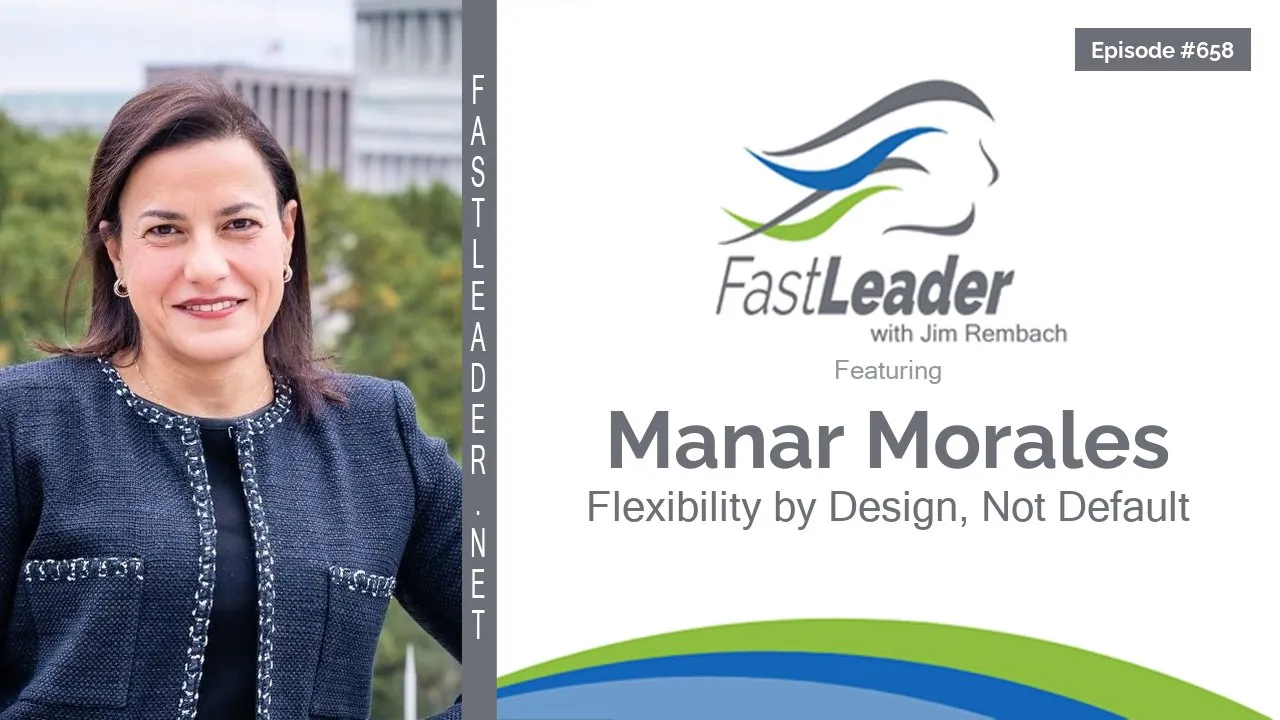
Manar Morales explains how workplace flexibility designed around outcomes, not presence, can reduce hybrid friction and protect accountability.
Watch on YouTube, or take the audio with you.