
Unleashing Strategic Success
We see the exact same dynamic when leaders attempt to navigate career transitions or enterprise growth using traditional forward-looking roadmaps.
The throughline connecting all the dots in his career, or what some would call his “Blue Flame,” is this: helping people find new ways to be successful.
Categoriesstrategy execution
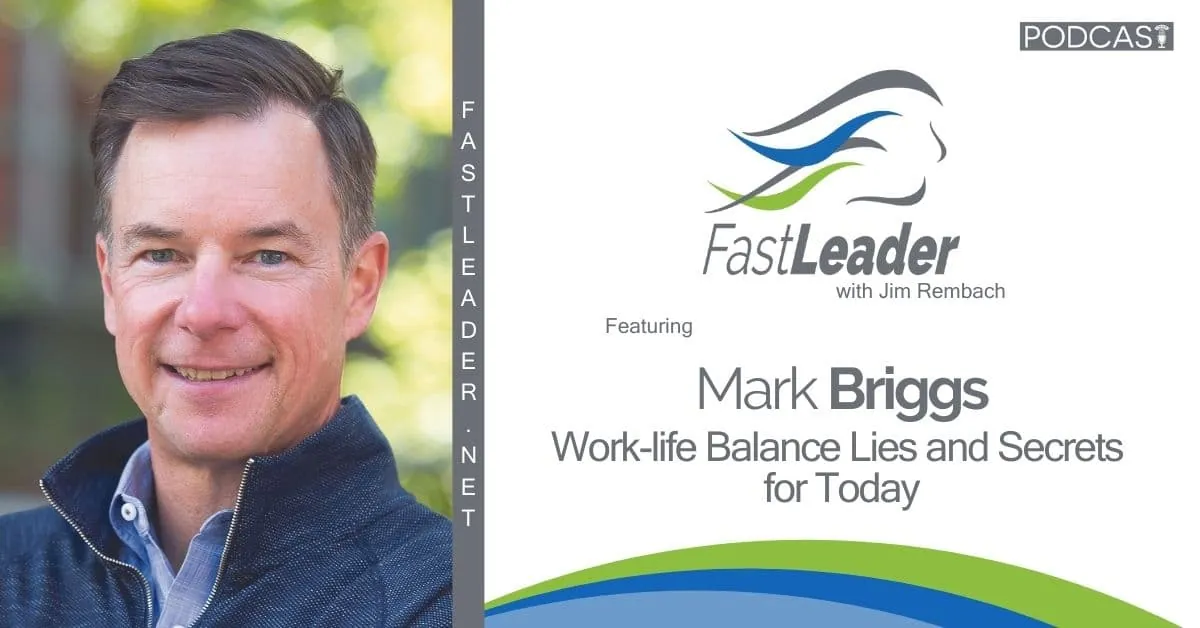
This Fast Leader Show episode covers work-Life Balance Lies and Secrets for Today. Here is what the conversation covers, then the key insights.
Most enterprise operating systems assume human beings can operate with infinite capacity under constant friction. When Mark Briggs reflected on his childhood in Coeur d’Alene, Idaho, jumping off lake rocks with childhood friends, he highlighted a foundational contrast to modern work life.
Executive Summary: Key Insights
The Blending Reality:
Sustainable operational performance requires shifting from rigid work-life balance metrics toward structured boundary agreements across teams.
The Biological Constraint:
Exhaustion and cognitive overload occur when enterprise demands exceed human capacity without supportive environmental scaffolding.
Micro-Interventions:
Small systemic adjustments in daily routines create compounding ripple effects that stabilize cross-functional momentum.
When Mark Briggs reflected on his childhood in Coeur d’Alene, Idaho, jumping off lake rocks with childhood friends, he highlighted a foundational contrast to modern work life. Most enterprise operating systems assume human beings can operate with infinite capacity under constant friction.
We try to solve this mismatch by asking leaders to push harder.
During a period of severe personal disruption, Mark navigated a high-stress transition, a brutal daily commute, and university teaching obligations at UNC simultaneously. He discovered that navigating operational pressure required setting rigid boundaries and prioritizing biological recovery through sleep discipline. When organizations fail to provide structural alignment, individuals are forced to rely on personal willpower, leading directly to Execution Drift.
Pause and reflect on what that means.
We often mistake constant activity for true enterprise impact. Mark shared how easily teams slip into the cult of busy, filling calendars with back-to-back meetings while losing connection to core organizational values. When stress rises, the Biological Autopilot takes over, causing leaders to revert to familiar legacy habits rather than maintaining intentional coordination.
Intentionally shifting a team call with simple human connection, like running a thankful Thursday check-in, demonstrates how micro-adjustments lower cognitive load. When we upgrade our environmental scaffolding to support human limits, alignment becomes the default outcome across the organization.
When enterprise complexity outpaces administrative design, human biological capacity reaches saturation. Under sustained operational strain, leaders naturally revert to low-effort autopilot routines to conserve mental energy. This systemic mismatch leads to delayed decisions, reactive firefighting, and unmeasured operational drag across functional silos.
Traditional initiatives treat work-life friction as an individual motivation or time management problem rather than a structural architecture issue. Mandating wellness programs without adjusting cross-silo coordination norms or boundary agreements forces employees to absorb systemic drag through personal effort. Sustainable performance requires upgrading the operational environment to fit modern operational velocity.
Unmanaged friction manifests as silent execution leakage, rework, project delays, and voluntary turnover of elite talent. When structural scaffolding is absent, organizations spend secondary capital recruiting replacement talent or remediating execution gaps. This unnecessary financial drain directly compresses operating margins without appearing as an explicit line item on the P&L.
Now that you see the bigger picture, what will you do differently?
Change is the only thing constant in the world. No matter what you do, change is inevitable. It can happen externally – out of your control – but it can also happen internally – within your control. But no matter what form change may take place, the question is, what are you going to do about it? Will you remain stagnant or will you take the opportunity to allow change to make you better? Remember, progress is optional.
With the change brought about by the pandemic, the majority of people have been forced into working at home. While working at home offered a solution to allow employees to work despite the lockdown, it has also brought about problems regarding work-life balance, or what Mark puts it, work-life blending.
The problem with working at home is that the line between work and home is often blurred. It has caused problems with remote workers and the majority has not found a solution for it. No boundaries have been set and oftentimes employees end up overworking and hurting their work life and home life. So, how do we deal with this problem? How do we create a healthy work-life balance without the lies and secrets of today?
In this episode, Mark Briggs share about the butterfly impact and how one small positive change you make internally can have a massive ripple effect externally. Similar to the butterfly effect, the butterfly impact is all about minor internal changes causing external significant results. The butterfly effect is about allowing you to achieve the work-life balance you are looking for, thereby allowing you to thrive and flourish in your personal life and excel in your professional life. Listen in as Mark shows you how.
Mark Briggs grew up in the idyllic Idaho lake town of Coeur d’Alene with a solid, loving family, surrounded by a large group of close friends and constant adventure—a storybook come to life. He attended college at Gonzaga University in Spokane with a plan to become a high school football coach. Both of his older sisters were in school there, and he had cousins, aunts, and uncles who were Zag alumni, too. It was a family thing and, if he learned nothing else from his parents, who have been married for 55 years, he learned to cherish family at an early age.
As a kid, Mark was a sports nut and especially loved football and basketball. From grade school through high school, he filled up notebooks with offensive plays that he had dreamed up, and, sometimes, his coaches would use the plays he invented. Given how little he played in some of the games, he was happy to make an impact any way he could.
He discovered sportswriting and journalism in college, then digital journalism and newspapers and TV news, and started writing books about it all. He also tried launching a couple of startup companies, but they didn’t take off. For the past five years, he’s been helping media companies with change management and modernization projects.
Over the past few years, conversations with his clients led to a new book project during the pandemic, focusing on work-life happiness. He realized even before the pandemic that business strategy carried little impact if the people who needed to execute the strategy were burned out, stressed out, and overwhelmed. These conversations led him to write and publish The Butterfly Impact: Resilience, Resets and Ripples.
The throughline connecting all the dots in his career, or what some would call his “Blue Flame,” is this: helping people find new ways to be successful.
His first book, Journalism 2.0, was made possible by a grant from the Knight Foundation and published in 2007, translated into five languages, and downloaded more than 200,000 times. Since then, he has worked with groups globally on finding new ways to be successful and written three other books. In addition to writing books and working as a management consultant, Mark is also a professor of leadership and change management at the University of North Carolina, Chapel Hill, and teaches a similar course for Aga Khan University in East Africa.
Mark lives in Tacoma, Washington, and is proud to live in the Pacific Northwest, surrounded by mountain and water adventures. He has two sons, ages 21 and 19, and a new rescue dog named Mars. He shares insights on innovation, work-life harmony, and leadership on LinkedIn and through a bi-weekly newsletter. You can subscribe at www.butterfly-impact.com.
Listen to @markbriggs get over the hump on the @FastLeaderShow – Click to Tweet
“The paradox is that the more capable you are, the more you are tempted to try and deal with infinity by yourself.” – Click to Tweet
“Very small changes can have really big effects downstream.” – Click to Tweet
“An individual can make really small changes in their own life to have an outside effect on the people around them, both at work and at home.” – Click to Tweet
“You can take the change and uncertainty that’s forced upon you and turn it into something positive and come out of it a better person.” – Click to Tweet
“Until you know where you stand, it’s not possible for you to take a stand.” – Click to Tweet
“Now that you have had the work-life balance and blend, have those conversations about what are the boundaries that as a team you value now.” – Click to Tweet
“One of the lies about work-life balance in this day and age is that anybody has it totally under control.” – Click to Tweet
“The idea of how busy you are is how valuable you are is just really outdated.” – Click to Tweet
“Change is inevitable and progress is optional.” – Click to Tweet
Resilience. Learn to be more resilient.
Ego. The inability to be as vulnerable as needed to be as effective as I could be.
Listen first, ask second.
Positive energy that gives a sense of we can do anything.
The Second Mountain: The Quest for a Moral Life
The Butterfly Impact: Resilience, Resets, and Ripples
Mark’s website: https://www.butterfly-impact.com/
Mark’s book: https://amzn.to/3ofkBSN
Mark’s Twitter: https://twitter.com/markbriggs
Fast Leader Show on YouTube: https://www.youtube.com/c/FastleaderNet
Fast Leader Show on Apple Podcast: https://apple.co/364qAA2
Fast Leader Show on Facebook: https://www.facebook.com/FastLeaderShow
Fast Leader Show on Twitter: https://twitter.com/fastleadershow
Fast Leader Show on LinkedIn: https://www.linkedin.com/company/fastleader.net
Check out other episodes on positive change: https://www.fastleader.net/bob-quinn/
Thanks for tuning into this week’s episode! If the information in our weekly conversations and interviews have helped you in your journey, please head over to Apple Podcasts, subscribe to the Fast Leader Show, and leave us an honest review.
Your reviews and feedback will not only help us continue to deliver great, helpful content, but it will also help us reach even more amazing people just like you!
Fast Leader Show is the official podcast of Execution Architects. To build alignment with a post-AI operating system, visit executionarchitects.com.
We see the exact same dynamic when leaders attempt to navigate career transitions or enterprise growth using traditional forward-looking roadmaps.
As class ended, a student patted the top of his own head and remarked on the great lecture, signaling that the material had gone completely over his head.
When frontline leaders are forced to manage cross-silo coordination through manual oversight, biological autopilot routines take over to conserve energy.
This creates internal coordination drag, forcing teams to spend vital cognitive capacity managing internal processes rather than delivering market value.
Watch on YouTube, or take the audio with you.