
Unleashing Strategic Success
We see the exact same dynamic when leaders attempt to navigate career transitions or enterprise growth using traditional forward-looking roadmaps.
With Sean T. Ryan
Early in his career, Sean Ryan found himself at twenty-six years old managing thirty-five veteran technical professionals at Pacific Gas and Electric.
Categoriesstrategy execution
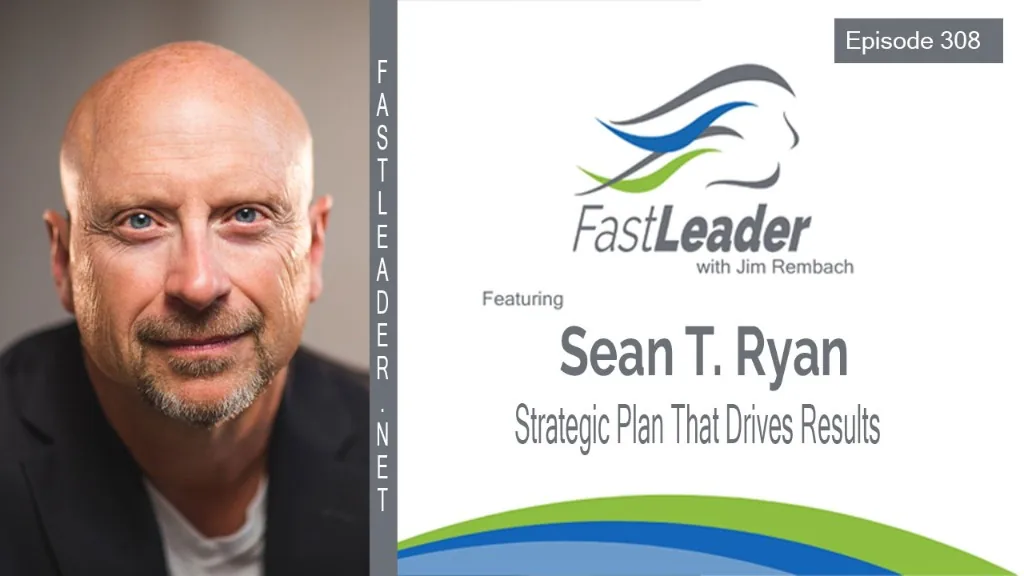
This Fast Leader Show episode is strategic Plan That Drives Results with Sean T. Ryan. Here is what the conversation covers, then the key insights.
Ryan Show Notes Page Early in his career, Sean Ryan found himself at twenty-six years old managing thirty-five veteran technical professionals at Pacific Gas and Electric. Every single person on that engineering team had been at the utility longer than Sean had been alive.
Executive Summary: Key Insights
System Architecture Over Willpower:
Strategic execution stalls not from poor intent or lack of talent, but because outdated administrative systems fail to support frontline operational reality.
Managing Strategic Alignment:
Organizations achieve rapid performance turnarounds by focusing on structural alignment levers rather than trying to fix every operational variable simultaneously.
The Friction of Legacy Systems:
Unintentional communication barriers between executive strategy and frontline execution create operational drag that erodes enterprise value.
Early in his career, Sean Ryan found himself at twenty-six years old managing thirty-five veteran technical professionals at Pacific Gas and Electric. Every single person on that engineering team had been at the utility longer than Sean had been alive. He quickly recognized that trying to out-engineer his team was impossible, so he shifted his focus to clearing bureaucracy and creating operational space for them to succeed.
That realization changed everything.
When Sean later led the turnaround at Callaway Gardens, the resort was bleeding cash and trapped in a downward operational spiral. By systematically realigning the operating environment and team focus, his leadership team turned negative cash flow into positive cash flow in less than eighteen months. Later at Perrier Group of America, rapid acquisitions created eighty-three distinct plant cultures across North America. Traditional wisdom suggested a cultural unification of that scale would take seven years, yet his team completed the alignment in under two years by restructuring the underlying organizational architecture.
The effort was real, but the breakthrough came from changing the system.
Most strategic plans do not stall because leaders lack discipline or vision. They stall because organizations rely on legacy administrative designs built for a slower era, triggering the FONE Factors as complexity grows. When executive intent fails to penetrate the operational layers, organizations pay an invisible Drift Tax that quietly erodes financial performance and team engagement.
Sit with that for a moment.
And I will be honest with you, I missed this structural reality myself for years. We often assume that giving talented people better goals or more training will naturally yield better operational execution. But human capacity has limits, and without supportive environmental scaffolding, even the most brilliant strategic plans dissolve under daily operational friction.
What will you do with this insight?
Strategic plans rarely fail due to flawed logic or lack of leadership commitment. Failure occurs when organizations attempt to execute modern, high-velocity strategies using legacy administrative designs that rely solely on human willpower and manual coordination. As operational complexity increases, this mismatch creates systemic friction, causing frontline behavior to shift away from executive intent and degrading financial margins.
Accelerating alignment across disparate workplace cultures requires shifting focus from passive training workshops to structural system architecture. Organizations must establish clear, visible scorecards and align operational processes directly with strategic objectives. When leaders remove administrative friction and provide environmental scaffolding, teams naturally synchronize their daily actions without requiring years of cultural assimilation.
Traditional management relies on top-down enforcement to force compliance, which rapidly exhausts cognitive capacity and increases turnover during organizational stress. An execution system creates structural alignment levers and clear operational pathways that guide daily behavior in the flow of work. By addressing systemic constraints rather than blaming individual effort, organizations sustain high performance while preserving talent density and leadership capacity.
A good strategic plan is never enough unless you are able to drive results from them. Any call center or business can develop a good strategic plan, but not everyone can drive results and execute on them. So, how do you exactly develop a good strategic plan that drives results? How do you take action and get those gears in place and get your strategic plan from strategy to execution to results? In this episode of the Fast Leader Show, Sean T. Ryan of WhiteWater International Consulting shares his actionable advice on how exactly you can do that!
Sean Ryan grew up in Hamilton, Ohio, just outside Cincinnati. He has two older sisters, and played a variety of sports as a kid. That love for sports eventually led to his future adventures, including backpacking, whitewater canoeing, biking, boating, sailing, and golf. His family instilled the values of integrity, respect, and hard work to achieve success.
He was inspired to pursue an engineering degree in his early teenage years when one of his sisters took him to a computer lab where he got to play Pong on an ancient cathode ray tube monitor. That engineering degree, combined with his passion for whitewater, led him to his first corporate role in technical sales at Pacific Gas and Electric (PG&E) in California.
Sean held a variety of sales, marketing, and engineering roles at PG&E while he also obtained his MBA at night school. While at PG&E, he had the opportunity to work with a lot of great, talented people who were often stifled in their efforts to perform their best. This led to Sean discovering what has become his lifelong passion and mission: to create great organizations where everyone can contribute their best.
The first step in that mission was to join a small boutique consulting firm headquartered in the San Francisco-area. He has essentially been on that mission for the last 30+ years, including a couple of significant sabbaticals from his consulting practice. In the first, he served as Vice President of Learning and Organizational Development for Perrier Group of America (now Nestle Waters North America) as it experienced exponential growth.
Sean and his team helped shaped the culture and built the talent pipeline that enabled that growth. In the second sabbatical, Sean led the turnaround of Callaway Gardens as the Chief Operating Officer and General Manager. Sean and his team revitalized the guest experience, reengaged the Callaway team, and turned the resort from significantly negative cash flow to positive cash flow in less than 18-months.
Sean’s consulting firm, WhiteWater International Consulting, works with organizations from start-ups to Fortune 100-sized companies to create the strategy, drive strategy to results and develop the leadership capacity to engage teammates in a rapidly changing environment fully.
His book, Get in Gear: The Seven Gears that Drive Strategy to Results, translates his thinking into practical guidance to enable both organizations and individuals to achieve success.
Sean is a member of the Board of Fundy Gymnastics. He regularly speaks, writes, and blogs about creating and executing strategy and leadership.
Sean currently lives outside Saint John, New Brunswick, Canada, with his spouse Heather and their son Aidan. Sean also has two gainfully employed adult children living in the US!
Listen to @wwici get over the hump on the @FastLeaderShow – Click to Tweet
“If you always do what you’ve always done, you’re going to get what you’ve always got.” – Click to Tweet
“If you always think the way you’ve always thought, you’re going to do what you’ve always done, so you’re going to get what you’ve always got.” – Click to Tweet
“The real key to be different is to think differently.” – Click to Tweet
“It’s not about being perfect. It’s about the relentless pursuit of being better everyday.” – Click to Tweet
Sean Ryan was put in charge of an engineering team that had more experience than he had been alive. He wanted them to be more focused on the customer, but he could not possibly dictate any decision to them because they were more experienced than he was. Not really knowing what he could bring to the table, Sean tried to figure out what value that he could bring to the team, and he realized that if he could create space for them from the bureaucracy within the company, then they would be able to perform better and be incredibly successful at what they do. From that experience, Sean was able to learn to think on what his role is as a leader and what he brings to the table when he can’t tell anybody to do anything of substance.
You don’t need to be perfect.
Myself.
Keep smiling.
Combination of creativity to solve problems and the persistence to don’t stop until they get solved.
Being able to listen to people as empathetically as I possibly can.
Get in Gear: The Seven Gears that Drive Strategy to Results
Influencer: The Power to Change Anything
Sean Ryan’s Twitter: https://twitter.com/wwici
WWICI website: https://www.wwici.com
WWICI Facebook: https://www.facebook.com/wwici
WWICI LinkedIn: https://www.linkedin.com/company/wwici
Fast Leader Show on YouTube: https://www.youtube.com/c/FastleaderNet
Fast Leader Show on Apple Podcast: https://apple.co/364qAA2
Fast Leader Show on Facebook: https://www.facebook.com/FastLeaderShow
Fast Leader Show on Twitter: https://twitter.com/fastleadershow
Fast Leader Show on LinkedIn: https://www.linkedin.com/company/fastleader.net
Thanks for tuning into this week’s episode of the Fast Leader Show Podcast! If the information in our weekly conversations and interviews have helped you in your journey, please head over to iTunes, subscribe to the show, and leave us an honest review. Your reviews and feedback will not only help us continue to deliver great, helpful content, but it will also help us reach even more amazing people just like you!
Fast Leader Show is the official podcast of Execution Architects. To build alignment with a post-AI operating system, visit executionarchitects.com.
We see the exact same dynamic when leaders attempt to navigate career transitions or enterprise growth using traditional forward-looking roadmaps.
As class ended, a student patted the top of his own head and remarked on the great lecture, signaling that the material had gone completely over his head.
The throughline connecting all the dots in his career, or what some would call his “Blue Flame,” is this: helping people find new ways to be successful.
When frontline leaders are forced to manage cross-silo coordination through manual oversight, biological autopilot routines take over to conserve energy.
Watch on YouTube, or take the audio with you.