

Unlock Your Potential: A Numbers Game to Success
Kyle Austin Young explains how risk-aware planning improves the odds of complex goals when success depends on many connected decisions.
Managers often stall when facing mountains of numbers because they erroneously believe advanced mathematics is required to make sound choices.
Categoriesstrategy execution
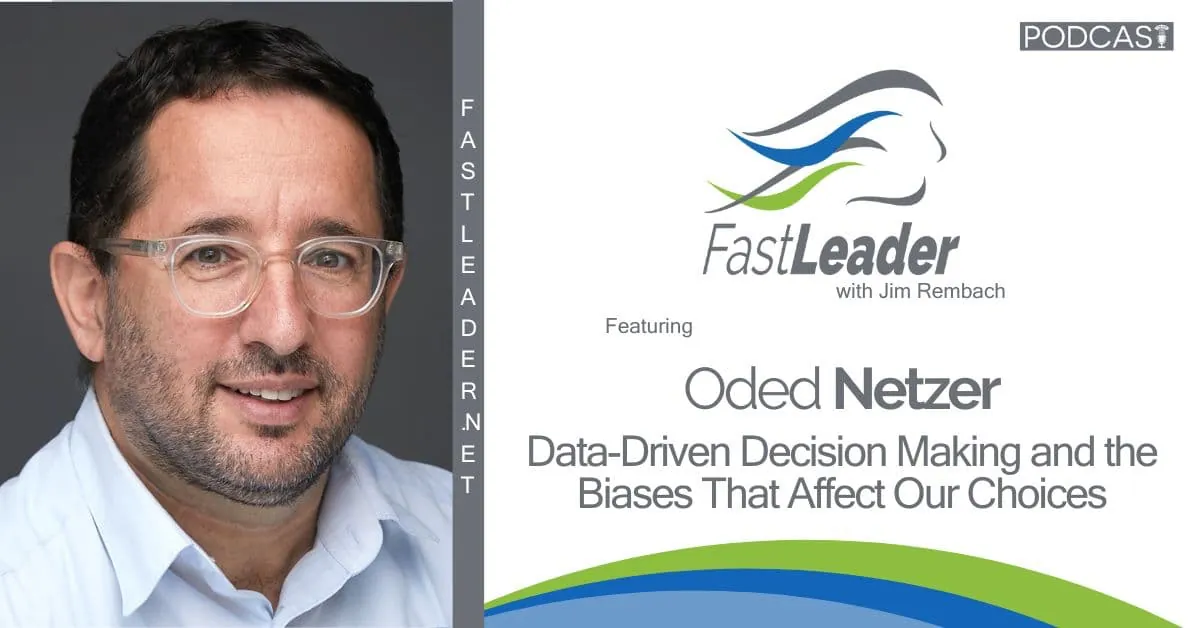
This Fast Leader Show episode covers data-Driven Decision Making and the Biases That Affect Our Choices. Here is what the conversation covers, then the key insights.
That early curiosity led him from industrial engineering at the Technion to Stanford and Columbia Business School, where he recognized a recurring friction in leadership. Managers often stall when facing mountains of numbers because they erroneously believe advanced mathematics is required to make sound choices.
Executive Summary: Key Insights
Quantitative Intuition:
Combining business acumen with data analysis prevents organizations from spinning in search of non-existent perfect certainty.
Decision-Driven Analysis:
Working backward from two-way door choices using structured questions isolates vital signals while filtering out operational noise.
Structural Alignment:
Blending lived operational experience with data analytics shields decision-makers from systemic drift and cognitive overload.
When Oded Netzer recalled his childhood in Haifa, Israel, he described playing street soccer with goals made of simple stones and taking apart machines his father brought home without ever reassembling them. That early curiosity led him from industrial engineering at the Technion to Stanford and Columbia Business School, where he recognized a recurring friction in leadership. Managers often stall when facing mountains of numbers because they erroneously believe advanced mathematics is required to make sound choices.
We buy into the illusion that more data automatically yields absolute certainty.
Let that thought sink in for a moment.
Research from the Leadership Execution Institute reveals that traditional change management fails because machine-scale data velocity quickly exceeds human cognitive capacity. When organizations fall into this trap, leaders constantly ask to see more data, creating systemic Execution Drift while execution stalls across operational silos. At Amazon, Oded noted how teams combat this friction by writing press releases for future products before building them, using structured questions to work backward from the decision point.
The goal is not to eliminate uncertainty, but to design an operating environment that renders decisions actionable.
I’ll be honest, I missed this for a long time myself.
During a recent coaching clinic with college baseball coaches, a veteran recruiter remarked that despite all the modern tracking software available, you still cannot teach a new dog old tricks. He was pointing to the necessity of synthesizing raw data with lived human experience, much like how Chris Frank at American Express uses structured framing to focus teams on missing variables. When we rely on our Biological Autopilot under operational pressure, we either cling to biased gut instincts or freeze in analysis paralysis.
Upgrading the underlying administrative design bridges the gap between strategic intent and frontline execution.
Now that you know this what will you do differently?
Traditional data initiatives treat execution as a math problem rather than an operating system challenge. When organizations flood teams with metrics without updating their administrative infrastructure, human cognitive capacity is quickly exceeded. This mismatch forces leaders into an operational risk reflex where they endlessly request more data to avoid making a call. True execution velocity requires structural scaffolding that filters out irrelevant data and aligns intuition with measurable choices.
Organizations frequently treat every choice as an irreversible, one-way door decision, which creates severe cognitive load and stalls momentum. When leaders classify reversible choices as two-way doors, they lower biological friction and allow teams to act on incomplete data. If a decision is irreversible, breaking it down into smaller intermediate steps restores decision agility. This structural approach protects margin stability while preventing execution drift across departments.
When decision-makers use data merely to validate pre-existing biases, the organization pays an unmeasured toll on the P&L through missed strategic opportunities and redundant spend. Strategic initiatives fragment across silos because the legacy operating system lacks real-time alignment levers. Over time, this systemic friction degrades operational margins and exhausts executive capacity. Installing governed execution pathways ensures that capital deployment yields compounding performance rather than corrective rework.
In this episode of the Fast Leader Show, we are joined by Oded Netzer, a Columbia Business School professor and Amazon Scholar. Oded, an expert in data-driven decision making, discusses common biases like overconfidence, availability, and confirmation bias that can hinder our use of data.
He introduces the powerful IWIK (I Wish I Knew) tool, which focuses on identifying key questions rather than complex statistical analysis. We delve into the concept of quantitative intuition, emphasizing the value of precision questioning, contextualizing data, and synthesizing information for decision-making.
Oded reveals the importance of combining data with intuition and building teams that understand both business and data science. He also discusses his book, “Decisions over Decimals,” which promotes starting with a decision and embracing uncertainty.
Finally, we examine the role of context in data analysis and the dangers of data without context. Join us as we navigate the nuanced world of data-driven decision making.
Oded Netzer was born and raised in the Mediterranean city of Haifa Israel. He has an older brother and sister. As a kid, Oded enjoyed playing soccer in the street with goals being simple stones they found on the roadside and taking apart parts of machines his father brought back home from work, which he never bothered to reassemble.
His father is a German Jew born a few years before WWII started. He is a holocaust survivor who spent WWII fleeing Nazi Germany to Poland, Siberia, and Kazakhstan. After the war, he immigrated to Israel where he met Oded’s mother. Having skipped his entire education during the war, Oded’s father taught himself mechanical engineering.
Oded is a first-generation college student earning his industrial engineering degree from one of Israel’s top institutions, the Technion, Israel institute for technology. Being a first-generation college student, he took the whole thing seriously and stayed in college forever. As a recovered engineer after his undergraduate degree he started working in consulting, this is where he developed his passion for research, analytics, and business decision-making. He then decided to move to the other side of research to academia where he did his Master’s in statistics and PhD in marketing at Stanford. It used to take him 15 minutes to explain what he does for a living, and then Data Science became a household word. Oded then replaced the sun of California with the city life of New York where he is Arthur J. Samberg Professor of Business and the Vice Dean for Research at Columbia Business School, an affiliate of the Columbia Data Science Institute. He also splits his time between Columbia and Amazon where serves as an Amazon Scholar at Amazon’s advertising.
Oded is a world-renowned expert in data-driven decision-making in extracting meaningful insights from data. He has published dozens of papers and multiple book chapters on this topic and has won multiple awards both for his research and his teaching.
Teaching analytics to MBA students and executives at Columbia, he noticed that managers often fear using data for decision-making because they erroneously believe that you need to be top of your class in math to do so. That led him to write a book with Chris Frank, and Paul Magnone about data-driven decision-making called Decisions Over Decimals: Striking the Balance between Intuition and Information.
Oded and his wife Susan, an HR consultant, reside in Manhattan next to Columbia University with their three children, Talia, Ella, and Aviv, along with their Cavalier King Charles puppy, Toby.
Listen to @OdedNetzer get over the hump on the @FastLeaderShow – Click to Tweet
“Now that we have data, it is actually the intuition to pour judgment into the data. It’s the intuition in order to combine actually our business acumen, our experience, our intuition with information that’s arriving at us.” – Click to Tweet
“The biases that affect our use of data is the fact that we tend to judge the book by its cover, the fact that we tend to use the most readily available information to judge an action as opposed to digging in deeper when needed.” – Click to Tweet
“Data without context is dangerous.” – Click to Tweet
“FOMO is exactly the reason why we looking for this perfect decision, this illusionary perfect decision, this illusionary certainty.” – Click to Tweet
“One important thing about risk and specifically related to FOMO is something we call a two-way door decision versus one-way door decision.” – Click to Tweet
“What is needed are exactly these skills to ask the right questions of the data, the precision questioning, the ability to contextualize the analysis, whatever the analysts provide, put in the context of the business, and finally synthesize it into making decisions.” – Click to Tweet
“What you need is data translators. It’s actually almost a new and emerging career path, those who understand enough of the business and understand enough of the data science to speak the language.” – Click to Tweet
“Our goal…was first to demystify the myth of the perfect decision…to introduce…this new set of skills, this new muscle that we call quantitative intuition, to see how we actually, truly move into a better world of data-driven decision making.” – Click to Tweet
The skill of patience, the skill of embracing the journey right as you are going through it, as opposed to just looking towards the end goal, realizing that a lot of what is happening is actually in the journey itself, not only in the outcome.
The ability to synthesize information, the ability to actually combining thing and connecting dots.
Spend time with the problem. Before you jump into a solution mode, spend time with a problem.
Context – my capacity to critically evaluate information, drawing from diverse knowledge and environments, to uncover connections that might initially seem unrelated – a human skill that surpasses machines.
Everybody Lies: Big Data, New Data, and What the Internet Can Tell Us About Who We Really Are
Decisions Over Decimals website: https://www.dodthebook.com/
Oded’s LinkedIn: https://www.linkedin.com/in/oded-netzer-700255/
Oded’s Columbia profile: https://www8.gsb.columbia.edu/cbs-directory/detail/on2110
Fast Leader Show on YouTube: https://www.youtube.com/c/FastleaderNet
Fast Leader Show on Apple Podcast: https://apple.co/364qAA2
Fast Leader Show on Facebook: https://www.facebook.com/FastLeaderShow
Fast Leader Show on Twitter: https://twitter.com/fastleadershow
Fast Leader Show on LinkedIn: https://www.linkedin.com/company/fastleader.net
Check out other episodes on data insights: https://www.fastleader.net/dei-strategies-data-backed-insights-leadership
Thanks for tuning into this week’s episode! If the information in our weekly conversations and interviews have helped you in your journey, please head over to Apple Podcasts, subscribe to the Fast Leader Show, and leave us an honest review.
Your reviews and feedback will not only help us continue to deliver great, helpful content, but it will also help us reach even more amazing people just like you!
Fast Leader Show is the official podcast of Execution Architects. To build alignment with a post-AI operating system, visit executionarchitects.com.
Kyle Austin Young explains how risk-aware planning improves the odds of complex goals when success depends on many connected decisions.
When leaders face high operational pressure, punitive measures trigger protective biological reflexes that lead to information hoarding and risk avoidance.
Organizations must shift from static training initiatives to dynamic execution scaffolding that guides behavior directly within daily workflows.
We see the exact same dynamic when leaders attempt to navigate career transitions or enterprise growth using traditional forward-looking roadmaps.
Watch on YouTube, or take the audio with you.